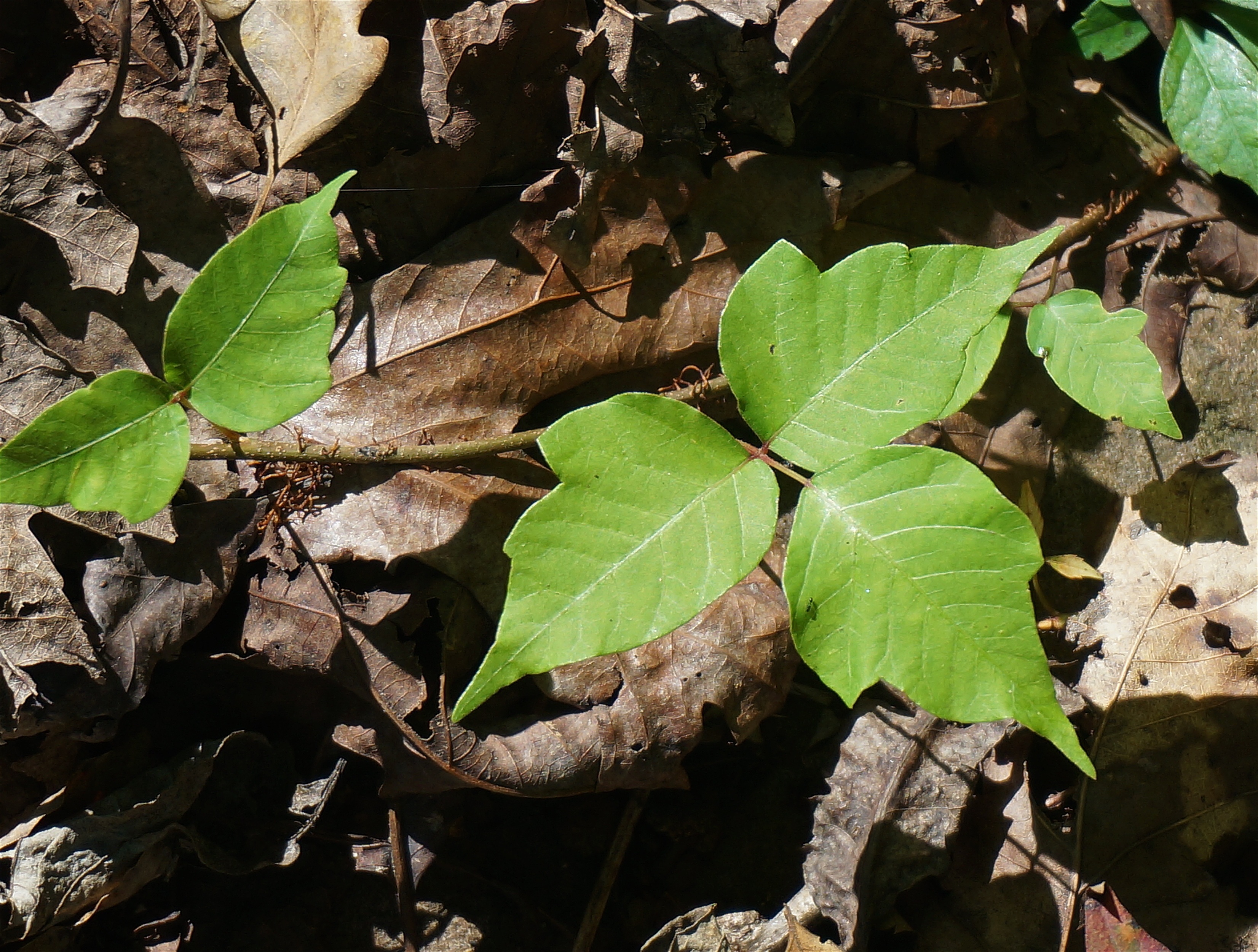
Poison ivy with three-part leaves growing along the forest floor. Image from Pixabay.
What is poison ivy?
Poison ivy is a poisonous wild plant native to much of the US, Mexico and Canada. As with any species of the genus Toxicodendron, all parts of the plant contain a toxic oil called urushiol that causes an itchy, irritating and sometimes painful rash in most people who touch it. Eastern poison ivy (T. radicans) is more common in eastern Nebraska, while western poison ivy (T. rydbergii) grows throughout the state. Poison sumac (T. vernix) and poison oak (T. diversilobum and T. pubescens) are not found in Nebraska.
What does poison ivy rash look like on skin?
Sensitive people (approximately 70% of Americans) often develop allergic dermatitis within 4-48 hours of their skin coming in contact with the plant. This is typically characterized as a linear, itchy red rash that gradually blisters and weeps over the course of a few weeks. Severity of the rash depends on how much urushiol was left on the skin and the sensitivity of the person exposed. Note that sensitivity can change with time, so even if you aren’t allergic now you could be in the future.
Is poison ivy contagious?
The rash itself, including any blister fluid, is not contagious. However, the urushiol that causes it can spread between people, pet fur, clothing, objects and parts of the body by touch if not cleaned off after initial exposure to the plant. There are also cases when the rash appears to be spreading to different parts of the body but in reality just hasn’t fully erupted yet. For instance, a staggered reaction to a single exposure can occur when areas of thinner skin (wrists, undersides of forearms) or skin with more urushiol break out sooner than other areas.
Think smart, roam safe!
While poison ivy can naturally be found growing in places where we live, work and play, there are effective ways to avoid that itchy red rash without staying inside. Consider the following safety precautions if you plan to spend time in any unmown or wild area.
- Cover up first. When venturing out, wear long sleeves and pants, a hat and socks and shoes that cover your feet. (This also plays into best practices for preventing skin cancer and bug bites.) Dry, loosely woven fabrics are ideal for keeping the oil from reaching your skin. Alternatively, commercially available products such as poison ivy barrier cream or protection wipes can work as cover when applied as directed. Safeguards for handling vegetation include wearing gloves, tying back long hair and refraining from touching your face or eyes as a rule.
- Plan for a way to clean your skin immediately upon exposure. Urushiol can be absorbed within 30 minutes of touching it, making quick clean-up important after suspected contact with poison ivy. This can be as simple as washing off at a nearby sink with soap and water. (No need for vigorous scrubbing, which can worsen exposure.) Keep a waterless poison ivy cleanser—such as IvyX wipes or a bottle of Tecnu and a towel—handy in your bag or vehicle for time in more remote areas.
- Always look before you leap. Scan up, down, and around for poison ivy upon entering a natural or overgrown area, keeping in mind that the plant can grow low as a groundcover, taller as a shrub or up a tree as a vine. Watch out in winter, too, since the oil remains in leaves, woody stems and roots even after they die or go dormant. If you identify poison ivy up ahead, don’t touch it! Double back and try a different route.
- Wash up afterward. This can be an especially helpful habit for hikers, campers, gardeners and people who regularly work outside. Upon returning from the great outdoors, wash down your gear with soap or rubbing alcohol and water to remove any possible urushiol. Then do the same for your shoes, covering your hands with disposable gloves or plastic bags if needed. After that, change out of your clothes and wash them with detergent in hot water separately from other items. Finally, take a normal shower (not a bath), avoiding complexion soaps with emollients or bath oils. Consider bathing any pets that came along, as well.
Does poison ivy affect animals?
Pets, livestock and other non-primates are not known to be sensitive to poison ivy. In fact, some land managers employ goats to eat the plant as a method of weed control. Poison ivy also serves as food or habitat for several forms of wildlife. Its berries are a favorite of many birds, such as songbirds and woodpeckers, which disperse the seeds after eating. Additionally, white-tailed deer and rabbits browse the leaves and stems while reptiles and amphibians use the plant for shelter. Beetles, flies, bees, wasps, ants, butterflies and other insects feed on the flowers in spring.
What does poison ivy look like?
Poison ivy can vary in habit and grow just about anywhere, making it tricky to recognize. In open, sunny situations like a prairie or field, it tends to grow densely as a bushy shrub. In the woods, poison ivy can take on a more relaxed habit, spreading in low patches along the ground or up a tree as a vine.

A key identification characteristic of poison ivy is the leaf, which is actually made up of three leaflets 1-4 inches long. Hence the adage, “leaves of three, let it be.” Leaflets are variable in shape and size, even on the same plant, and can be smooth-edged, irregularly toothed or lobed—sometimes with a “thumb” that makes them look like pointed mittens. Mature leaves are dark green, turning fiery red in autumn before falling away.


Look-alike plants
Several nontoxic species in Nebraska are often confused with poison ivy. Proper identification can be complicated by some of these plants growing interspersed with poison ivy in the wild, so observe closely. Here are the main ways to distinguish poison ivy from the rest.

Virginia creeper is a woody vine. While young leaves sometimes have only three leaflets similar to poison ivy, mature leaves have five leaflets all connected at a single point.

Boxelder is a tree that can look like poison ivy, especially as a seedling. However, any boxelder “leaves of three” are arranged oppositely along the stem rather than in an alternating pattern.

Wild grape vines commonly grow in wild places as poison ivy does, but their leaves are not compound and grow singly along the stem.

Fragrant sumac is a shrubby cousin of poison ivy with similar trifoliate leaves. Unlike poison ivy, none of its leaflets have stalks (petioles).

Wild raspberry and blackberry are also shrubs with trifoliate leaves; these species can be distinguished from poison ivy because they have prickly stems, finely toothed leaf edges or both.

Boston ivy is a vine that sometimes exhibits three-parted leaves; however, these are always young leaves—older leaves are three-lobed, but not separated like the leaflets of poison ivy.