
Insects, Spiders, Mice & More
Ant Identification
Return to:
Ant Identification Resources
Ant species can differ widely in their food requirements and behaviors. It is important to identify the type of ant before choosing a treatment. Once you've identified the key features, final identification is made from size, color, other body characteristics, habits, or other information.
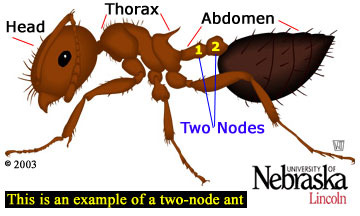
To help identify ants, they are grouped into "one node" and "two node" ants. The "nodes" are an important identification characteristic. (see graphic below).
One Node Ants
Two Node Ants
View & Print Free Ant Identification Keys
- One-Node Ants (770 KB)
- Two-Node Ants (805 KB)
 To Identify Ants - Learn the Key Features.
In order to see key identifying features on ants - especially very tiny ants - you need a hand lens or microscope.
Like other insects, ant bodies are divided into head, thorax, and abdomen. Ants also have a constriction between the thorax and abdomen that gives them a "pinched-waist" appearance. The constricted part of the abdomen is called the pedicel, and the fat, main part of the abdomen is called the gaster.
This resource was updated November 2015 by Soni Cochran, Extension Associate
For information on reproducing this article or using any photographs or graphics, read the Terms of Use statement
Nebraska Extension in Lancaster County is your on-line educational resource. The information on this Web site is valid for residents of southeastern Nebraska. It may or may not apply in your area. If you live outside southeastern Nebraska, visit your local Extension office